Japan's logistics are almost too good. So Korea's Willog sends its sensors where shipments go dark: across borders and out at sea
A precision machine leaves a factory in Japan and passes through trucks, warehouses, ports and ships before it reaches a customer abroad. If it arrives damaged, nobody can say where it happened. Korean startup Willog sends a sensor along with the cargo and keeps the record intact even when the signal drops at sea. We asked Chiguk Sung, who heads Willog's Japanese subsidiary, why Japan's domestic deliveries leave little room for his product, how the device is built for lost connections, how a vaccine scandal made temperature records mandatory in Korea, and how the data is starting to feed into insurance.
 DATA TIMES Editorial Team
Interview · 19 min

A precision machine shipped overseas arrives damaged. At that point, almost nobody can tell you where it was damaged.
On its way out of the factory, the machine rides a truck to the port, waits in a warehouse, goes into a container, crosses the sea on a ship, and gets loaded onto another truck at the other end. Each leg is handled by a different company, and each company keeps its own records, if it keeps any. So when someone opens the crate and finds a crack, there is no way to say whether it was dropped at the port, battered by the waves or bumped on the last truck.
In Japan, that gap is becoming the shipper's problem. Since April 2026, large shippers handling 90,000 tonnes or more of cargo a year have had to appoint a chief logistics officer (CLO) and file plans on how they manage freight. Logistics can no longer be left entirely to the carriers.
And between Japan and South Korea, a lot of expensive, fragile cargo is on the move.
Sensors that log a shipment's temperature and shocks are nothing new. What caught our attention, as people who work with AI and data, was a narrower question: does the record survive the trip across the sea, where mobile networks simply don't reach?
One company in South Korea is building its business around that blind spot: Willog.
So we were glad to get the chance to talk with Chiguk Sung, who heads Willog's Japanese subsidiary.
Here are the three things we learned, up front.
- There's little demand inside Japan
Japan's domestic deliveries are reliable and well run. Willog earns its keep on cross-border shipments that pass through several carriers and modes of transport. - The record keeps going when the signal doesn't
The sensor rides with the cargo, stores readings on the device while it's offline, and sends them all at once when it reconnects. - The data becomes evidence
Knowing which leg of the journey something happened on helps find the cause, settle who is responsible and process insurance claims.

Chiguk SungChiguk Sung
CEO, Willog Corporation (Willog Japan)
“Deliveries inside Japan are very reliable. Our value shows most when goods cross a border”── Chiguk Sung, in this interview
- Until 2018From Korea to Japan for universityBorn and raised in South Korea, came to Japan for university and completed a master's degree in economics at Tohoku University
- 2018–Sumitomo Mitsui Banking CorporationAbout seven years at one of Japan's three megabanks: corporate sales to small businesses, coverage of global companies' Japanese operations, and investments in overseas funds
- May 2025Joined WillogTook charge of building the business in Japan
- NOWCEO, Willog JapanRepresentative director of Willog Corporation, set up in April 2026, leading sales, business development and partnerships
From a megabank to a startup that follows cargo
 Ogasawara
Thank you for joining us, Mr. Sung. Could we start with your career so far?
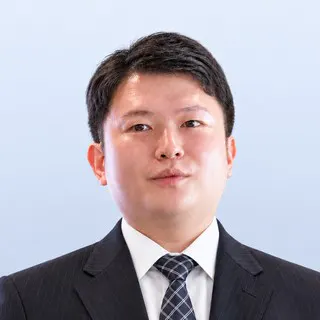 Sung
I was born and raised in South Korea, and my whole family is there. I came to Japan for university, finished a master's in economics at Tohoku University, and joined Sumitomo Mitsui Banking Corporation in 2018.
I spent about seven years at the bank. I started in corporate sales for small and mid-sized companies, moved in 2020 to the international corporate banking division covering the Japanese offices of global companies, and in 2024 moved to a team investing in overseas private equity funds.
The real turning point was the international division. Working with global companies, I saw firsthand how differently countries and companies make decisions, and how fast.
Banking was rewarding. You support companies' finances and help their projects happen. But finance means dealing with clients through their balance sheets or one project at a time. I'd always wanted to run a single business myself, from start to finish.
OgasawaraRunning a business from start to finish. And that's where Willog came in. How did you two meet?
SungThrough a Korean friend who was my junior at Tohoku University. One of Willog's current co-CEOs was his high school classmate back in Korea. When that co-CEO came to Japan on a business trip, my friend suggested we meet.
The timing was right. Willog was getting serious about entering Japan, and Japan needed better data on freight. New overtime limits for truck drivers were squeezing capacity, the so-called "2024 problem," and the logistics laws were being revised. Willog's idea, connecting the parts of a journey you can't see with data, fit Japan perfectly. I joined in May 2025 to run the Japanese business.
OgasawaraConnecting the parts of a journey you can't see. But taking that idea door to door in Japan, without a big bank's name behind you, must have been hard.
SungEverything changed at once: the country I was selling for, the industry, the size of the company. I wasn't too worried, but it was hard in practice. Selling without a big company's name behind you really is starting from zero, and I took plenty of detours.
My bank years help a lot, though. I covered companies in many industries, so I understand Japanese business manners and how internal approval, the ringi process, actually moves inside a company. That lets me tailor proposals to where a customer really is.
Trust matters too. Many customers value my megabank background, and some cheer me on for leaving a stable job to try something new. We've been active in Japan for only about a year, yet we're meeting major Japanese companies and running proof-of-concept trials with some of them. I'm enjoying it.
The more fragile and valuable the cargo, the bigger the fight
OgasawaraMajor companies are already trialing it. Within what you can share, who's reaching out to you?
SungOur customers are businesses, mainly manufacturers of goods that are sensitive to temperature or shock and worth a fair amount per unit, plus the logistics companies that move those goods.
In Korea, our biggest group is pharmaceuticals: medicines and vaccines. After that come precision equipment, semiconductors and chemicals. Car bodies, surprisingly, are also vulnerable to shocks.
Japan looks similar, but most inquiries come from global companies that do a lot of importing and exporting. Japan's domestic logistics infrastructure is excellent, and companies go to great lengths to prevent delivery accidents. Once cargo leaves Japan, though, that level of care is hard to maintain. That's where we come in.
OgasawaraSo, safe inside Japan, unknown beyond the border. What kind of problems do customers actually run into?
SungTake precision equipment. From the factory to a customer overseas, it passes through trucks, warehouses, ports and ships, and several different companies.
Before Willog, if a customer found damage on arrival, nobody knew which leg it happened on, when, or how hard the impact was. Records were split by leg, and each leg had a different operator. So both the cause and the responsibility stayed fuzzy. Companies ended up adding extra packaging without knowing why, or repeating the same accident.
The more expensive the product, the more likely people are to fight over who's responsible. Was it the maker, the carrier, or something after delivery? Without data, nobody has evidence, and if it goes to court it can drag on for a long time.
OgasawaraA fight over responsibility that can end up in court. With Willog, what does a shipment's journey look like?
SungLet's stay with the precision equipment export. Before shipping, the customer switches on our real-time sensor, the T1, and links it to the shipment in our system.
Where to put it, and how many, depends on the industry and how closely the customer wants to watch. For medicines, vaccines travel in boxes packed with ice packs, so we put a sensor in each box. For sea freight, the sensor is strapped in when the products on a pallet are shrink-wrapped. Sometimes one sensor per container is enough, but the front and back of a container can see different shocks and temperatures, so we may use two, three or more.
The T1 measures location, temperature, humidity, shock, tilt and light. By default it logs every 10 minutes and transmits every 60. The data goes over mobile networks to Control Tower in the cloud, where staff can follow the cargo on a map and on time-series charts. If a reading crosses a set threshold, they get an alert. When the shipment arrives and someone checks it in, the system automatically compiles the full record and a report.
Because the sensor moves with the cargo, the same device keeps recording from departure to arrival, even as the cargo moves from truck to warehouse to ship.

The signal drops at sea. The record doesn't
OgasawaraSo the same sensor makes the whole trip. But the sea is a special case. On big ships the signal can disappear, or other radio signals can interfere.
SungHonestly, connectivity is the one thing we can't guarantee 100%, however well we build the device. Depending on errors and timing, a connection sometimes fails. And out at sea, you simply enter areas with no coverage.
So the T1 stores its readings on the device at regular intervals and sends them in batches. If it can't connect for a while, it keeps recording, and once the connection comes back, it sends everything it has stored at once. Because you can check the data in time order, nothing important gets lost.
At sea, we also combine the ship's position from AIS, the automatic identification system ships broadcast, and organize the data leg by leg. That lets you trace afterward which mode of transport, and which location, an event happened at. We also have the V2, a model you collect at the end and download in one go. With a gateway, it can work in real time too.
 Ogasawara
Built on the assumption that the signal will drop, with recording and sending kept separate. That's a really thoughtful design. Does the sensor ever cry wolf, though? Even just opening the container doors could change the temperature.
SungFirst, calibration. We do three-point temperature calibration in line with ISO/IEC 17025, the international standard for calibration labs. On top of that, we judge temperature by how long a reading stayed outside the range, not by a single spike. In warehouses we also use mean kinetic temperature, or MKT. For shocks, we look at how many times they exceeded a threshold such as 2G, and where.
The light sensor also tells us when container doors were opened, so we can check whether a brief temperature change was just the doors opening. We set alert thresholds to fit each environment to cut down on pointless notifications.
When something unusual happens, alerts go to the registered contacts at the shipper or logistics company. They can be split into minor, moderate and urgent, each going to people at a different level. For medicines, the app can even walk staff through the return procedure as soon as a temperature excursion occurs.
Required by law in Korea, recommended by guidelines in Japan
OgasawaraIt even guides staff through returns. In Korea, systems like this are already used by many companies. Do Korea and Japan want different things from them?
SungThere are differences by industry and by regulation. On regulation, Korea is actually stricter than Japan.
In Korea, when you transport vaccines and similar products, you have to record the temperature and prove with data that it was properly controlled during transit and quality wasn't affected. It's effectively mandatory, so our service is something companies essentially have to use. The rules got tougher after temperature-control problems with vaccines during the COVID era.
In Japan, it's covered by guidelines from the Ministry of Health, Labour and Welfare. That doesn't mean companies do nothing because it's only a guideline. Japanese companies already take at least the basic measures, even without a legal requirement.
OgasawaraKorea made record-keeping a legal duty first, while Japan relies on guidelines. Are there differences beyond regulation?
SungBusiness customs. Compared with Korea and other countries, trading companies and wholesalers seem to carry more weight in Japanese industry.
Manufacturers concentrate on developing and making good products, and tend to rely on trading companies and carriers for sales and distribution. Our service can be introduced by the manufacturer, a trading company or a logistics company, but one way or another, the cost ends up in the manufacturer's logistics bill.
So we mainly approach manufacturers. But Japanese manufacturers often leave distribution, inventory and even payment collection to their trading companies. If nothing has gone wrong so far, they may be interested yet hesitant to take on the extra work themselves. The question of who carries the burden of managing it makes selling in Japan a notch harder.
OgasawaraSo "who carries the burden" is a wall specific to Japan. How are you approaching it?
SungRather than dwell on the differences, we're prioritizing industries where the need is highest.
In Korea, pharmaceutical companies are our largest group of customers, and we're strong in cold-chain logistics for medicines. In Japan, though, pharmaceutical distribution is largely in the hands of four major wholesalers. Turning our Korean strength into results here would take a long time. Medicines are also mostly a domestic business.
So we're reaching out more to customers in precision parts and semiconductors, and to companies that export a lot. Companies that trade a lot overseas have often been through accidents in transit, so they contact us more.
Domestic shipping is a different story. Japanese logistics companies are confident in their domestic service and take pride in it. So for purely domestic shipments, we get relatively few inquiries.
From evidence of an accident to insurance
OgasawaraJapan's logistics are almost too good, so there's little demand at home. That means the real opportunity is beyond the border. As the data piles up, what can you start to see?
SungAI is strongest at finding causes and patterns in large volumes of shipping data. We combine data on the cargo's condition, such as temperature and shock, with context: weather, season, when containers were opened, when goods went in and out of warehouses.
Say shocks of 2G or more keep showing up at one particular transshipment point. That strongly suggests the handling there is the cause. From there we can predict risky legs on future shipments and suggest precautions in advance.
That said, the final call belongs to experts. The sensor measures the environment around the cargo. It can't tell whether the product itself was damaged. Whether a medicine is still usable is for the quality assurance team to decide from stability data, and responsibility and insurance payouts depend on contracts and claims assessments. Until enough data has built up, AI alone can't establish cause and effect.
OgasawaraYou draw a clear line on what to leave to AI. Have you seen data change a customer's decision?
SungOne example is a Korean maker of specialty displays. After introducing Control Tower, damage in transit fell by 40%. We presented that result at a seminar in Korea in 2025.
In Japan, customers test very carefully before they commit. The usual path is to sign a nondisclosure agreement, run a small proof-of-concept trial, and only then sign a full contract.
For a trial, we agree with the customer on the route and product, the risk they want to check, temperature or shock, and the thresholds that count as abnormal. A typical trial uses a few to about ten sensors for about a month. It helps if the customer assigns people to attach the sensors and check shipments in, and shares records of past accidents for comparison. That makes the effect much easier to see.
OgasawaraSo you measure the effect against past records. I hear you're also connecting those records to insurance.
SungWillog Vision links four steps, record, respond, prove and compensate, with a single set of data. Our group provides the sensors, the real-time dashboard, the AI analysis and logistics insurance as one package.
In insurance, the data plays two roles. The first is evidence. When an accident happens, we generate a report from the raw, unedited data in the system and submit it to the insurer right away. That speeds up working out who is responsible and shortens the time until the payout.
The second is the basis for premiums. The accumulated data proves how well a customer manages risk, and becomes a bargaining chip when the policy comes up for renewal.
In Korea we also offer parametric insurance. If temperature, shock or a delay goes past a predefined threshold, the payout condition is met automatically, and the aim is to pay the pre-agreed amount within 15 days. It depends on having objectively measured data, like our sensors provide, and on fixing the payout conditions and amounts in the contract beforehand. Underwriting and the final payout are handled by insurance companies. In Korea, we started offering logistics insurance in spring 2026 and Willog Vision that September.
Every shipment moving between Japan and Korea
OgasawaraHow accurately you measure turns into money. What are you aiming for in Japan from here?
SungThe problem I most want to solve is not knowing the cause of damage, or who is responsible, in international shipments of precision equipment and semiconductor-related goods. Semiconductors in particular are one of the biggest categories of trade between Japan and Korea, so we want a much bigger share there.
What's in real use today is quality control with our sensors, Control Tower and Intelligence. In Japan, we're running trials with major logistics companies and major manufacturers. Beyond cargo leaving Japan, I want our system on everything that moves between Japan and Korea.
The other goal is partnership. If logistics companies that use our system can offer "logistics with quality proven by data," we can go to manufacturers together. In the long run, I want to connect the accumulated data to insurance and finance in Japan too, and make it a standard for judging transport quality objectively.
 Ogasawara
Finally, is there anything you'd like our readers to know?
SungJapanese manufacturers make a lot of competitive, important products. We want to help get them to their destinations safely, and we're looking for logistics partners to work with.
Once customers use our service, logistics and risk data keep accumulating. You start to see which route, which mode of transport, which weather or timing is risky. We analyze that data to help customers avoid repeating past accidents, and we're also building new businesses on it, including insurance. We want to find more companies in Japan to work with.
Logistics is shifting toward proving that nothing went wrong
What became clear from talking with Sung is that Willog's real product isn't the sensor. It's an unbroken record of a shipment's entire journey.
Japan's logistics are so good that the value shows up at the border
"We get relatively few inquiries for domestic shipping." Those words are also a sign of how strong Japan's logistics are. Domestic deliveries are reliable and problems are rare, so the value of a detailed record is hard to see.
Once cargo crosses a border, that changes. Carriers change hands several times, along with languages and business customs. Between Japan and Korea alone, semiconductor-related equipment and components worth hundreds of billions of yen move every year. A record that shows where something broke speeds up the cleanup, and it also informs the next decision about packaging and routes.
Since April 2026, large shippers in Japan have also had to name a chief logistics officer. The law doesn't require cargo sensors. Still, shippers will increasingly be asked to account for their goods' journeys.
Designed for the moment the signal drops
What I found most interesting was that Sung admitted up front that connectivity "can't be guaranteed 100%" and then showed how the system was built around that fact.
Recording and sending are separate. Readings are stored while offline and sent all at once on reconnection. The ship's position comes from AIS and the cargo's condition from the sensor, and they're matched afterward. Temperature is judged by how long it stayed out of range, not by a single reading. None of it is flashy. It's grounded design for protecting data in an environment where things break.
IoT that assumes a constant cloud connection works fine on land and falls apart at sea. If you build devices for the field, this is a good example of designing for the disconnect from day one.
Records will change how blame is shared, and what insurance costs
A sensor record becomes evidence of an accident, then a bargaining chip on premiums, and eventually a trigger for an automatic payout. Willog is working toward a world where logistics quality has a price tag, set by data.
That raises the stakes on measurement. Calibration, the rules for judging an excursion, handing over raw data. Sung took the time to explain these details of measurement carefully, and I took that as a sign that once insurance is involved, this is where trust is built.
If you're at a manufacturer that exports a lot, it's worth trying one route and comparing against your past accident records. For logistics companies, being able to prove quality with data may become a reason to be chosen.
With a record in hand, the time spent arguing over a broken crate about who did it becomes time spent deciding what to change next.
SOURCES ── References
- Willog, written answers to DATA TIMES's interview questions (received October 14, 2026)
- Willog Corporation, Willog to exhibit at Logis-Tech Tokyo 2026 (PR TIMES, September 1, 2026; in Japanese)
- Willog, Willog Vision announcement (September 17, 2026)
- Lloyd's, Lloyd's Lab unveils Cohort 17 (September 15, 2026)
- Willog, T1 product page
- Ministry of Finance Japan, Trade Statistics, exports by commodity and country (2025)
- Ministry of Finance Japan, Trade Statistics, imports by commodity and country (2025)
- Ministry of Land, Infrastructure, Transport and Tourism, leaflet for designated shippers (in Japanese)
- Yonhap News, national flu vaccination suspended over cold-chain failure (September 22, 2020; in Korean)
- Newsis, recall of 480,000 flu vaccine doses (October 6, 2020; in Korean)
- Korea Law Information Center, amendment history of the Rules on Manufacturing and Sales Management of Biological Products (in Korean)
- Ministry of Health, Labour and Welfare, Good Distribution Practice guidelines for pharmaceuticals (December 28, 2018; in Japanese)
- IMO, AIS transponders
- ISO, ISO/IEC 17025:2017
- USP, 〈1079.2〉 Mean Kinetic Temperature in the Evaluation of Temperature Excursions During Storage and Transportation
- Swiss Re Corporate Solutions, What is the most popular parametric solution? Cat in a box explained (April 8, 2020)


